
Honey bees are incredible little social creatures. Their ability to shift between worker roles, build perfect hexagons, waggle dance location information, and maintain a functioning colony of tens of thousands will captivate your children’s minds. They are fascinating to learn about! And, hopefully, when kids have knowledge about the lives of bees and not just fear of their stingers, they will remain calm and protective when observing them outside.
It’s not unusual for children’s books to make suggestions on how to be kind to bees. No swatting. Watch from a distance. Plant flowers. But what about the message they contain about taking the bees’ honey? Authors detail the hard work that goes into making it, the small amount produced by each forager (1/12th teaspoon in her lifetime!), their willingness to die as hive guards, and then, quite nonsensically, they include a recommendation that readers enjoy its sweet taste. Wait..what?!

Bees don’t give us honey just like cows don’t give us milk. It’s made by bees for bees, and as you can see in the bulleted list below, the process of keeping bees for honey involves many forms of abuse. We started this post with the intention of highlighting books that would allow teachers and parents to share information about bees without including the cruel practices that humans inflict on them to obtain honey and beeswax products which are unnecessary to our species. And there are titles for this shared below!
But surprisingly, and more importantly, we discovered that honey bees are only one of 20,000+ species of bees. They are not even native to America and are only raised here to produce honey and crops of our choosing. Unfortunately, like other domesticated, farmed animals they’re mistreated, exploited, disease-prone, and bred for certain money-making traits. So if your goal is to talk to children about pollination in our natural ecosystem, there are a lot of better subjects than the honey bee.
And if you want your kids to learn to help pollinators, we don’t need them to become backyard beekeepers! We actually don’t need more honey bees at all. The Colony Collapse Disorder emphasized by the media is impacting the industrial bee businesses involved in honey sales and monoculture crop fields which cannot be the way of the future. It’s the population decline of wild bee species that ecologists in our meadows and forests are recording that is most concerning. To boost these numbers, we need children to learn to grow native flowers, avoid herbicides and pesticides, provide natural or handmade nesting sites and water sources, and support local, organic farmers growing a variety of foods with the help of native pollinators. If you know of books that can check those boxes, please help us add to this list!
Why is eating honey harmful to bees?
- Bees Have to Work Harder
- Bees make honey to have stored food for the winter and when it is taken by humans they must produce more than normal to replace it
- Beekeepers who insert supers into a hive trick the colony into stressing to fill the additional empty cells with honey
- Bees Are Injured or Killed
- The queen bee is killed and replaced after her prime egg-laying years are over
- During inspection of the hive boxes and extraction of honey, bees can be trapped or crushed as the frames are pulled out and reinserted
- Queen bee wing clipping is practiced to prevent swarming and queen marking requires the application of paint or stickers to her body so she can be easily identified
- Artificial insemination involves fatally extracting semen from drones and inserting it into a restrained queen bee
- Full hives are destroyed when deemed necessary using fire, dry ice, soap, sulfur dioxide, gasoline/alcohol fumes
- Hives refrigerated to combat parasites or made from inappropriate materials for the winter expose bees to cold temperatures and cause high levels of discomfort
- Honey bees are selectively bred to produce more honey which leads to loss of genetic diversity and increased susceptibility to diseases and pests
- Native Bee Species are Impacted
- European honey bees were introduced to this continent by settlers and now compete with species that evolved to best pollinate the plants of North America
- Diseases are spread to wild bees from commercial pollination hives transported to temporarily pollinate fields and orchards
- Bees are Fed an Unnatural Diet
- Bees are fed replacement sugar syrup and protein patties to make up for a lack of honey and pollen available to them after stores are taken, and the missing nutrients and microbes usually obtained from the flowers can impact the colony’s immunity
- Bee hives trucked to monoculture fields do not get nutrition from a variety of plants
- Bees Are Manipulated With Smokers
- Beekeepers overpower communication pheromones secreted by guard bees to alert the colony of an intruder and allow them to plan an attack
- Bees respond to potential fire by gathering honey in their abdomens to transport to a new home which keeps them busy and pacifies their stinging ability
- Bees are Stressed by Relocation
- Bees can be purchased from suppliers and are forced to endure various temperatures and handling conditions during shipment and storage
- Hives are transported long distances in netted flatbed trucks to be rented out to fruit farmers (read The Honeybee Highway by Upchurch for a picture book on the process, but be prepared to voice your own concern for the bees’ experience)
- Colonies are reorganized at the beekeeper’s discretion–separated or combined (queen killed) for best productivity at times never chosen by the community
- Bees Are Exposed to Chemicals
- Beekeepers treat parasites and diseases in their hives with substances
- Pesticides and herbicides in agricultural fields impact the foragers
- Like with other domesticated livestock, antibiotics are used by large-scale producers
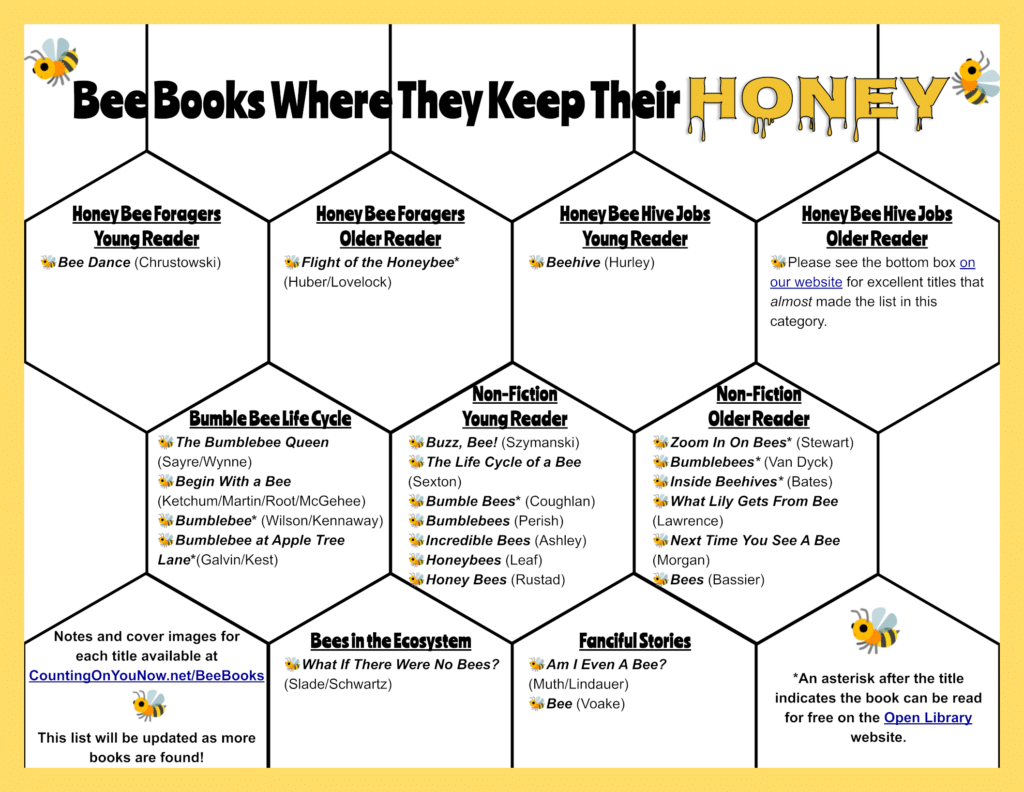
The books in the following list were selected because they do not encourage humans to eat honey or mistreat bees for profit. If pollination is included, it is explained as a process that enables plants to reproduce not “grow,” and the bees’ role of spreading pollen is not presented as a deliberate action to do their important part. We have included books about other kinds of bees even though none of them produce honey that is consumed by humans because books for young readers often use many species interchangeably for the word “bee” and because pollination, the food chain, and the life cycle of an insect can all be studied using a native bumblebee without ever having to mention the topic of beekeeping. The books are divided into groups based on their main topic, target audience (lower or upper elementary), and whether the text is supported by illustrations or photographs.
🌷 A flower at the end of the notes for a book indicates the author also included back matter (pages of information after the main text) to provide extra details about bees for the adult or child reader. The learning continues!
Honey Bee Roles in the Hive
In these books readers discover the many different jobs that worker honeybees have during their lifetime. From birth, metamorphosis from larvae, through the different roles, and sometimes even including death, the entire life cycle is explored. As adults, female honeybees spend time as cleaners, nursery caretakers, builders, queen servants, food producers, guards, foragers, guides, and scouts. The difference between their lives and that of the queen and drones are also explained when noted below.
For Young Readers

For Older Readers
🐝Please see the note at the bottom of this post about books that almost made our list. There are a few excellent ones for this category in the orange box!
Honey Bee Foragers
The titles below focus on the honey bees who leave the hive to collect food. Facts about navigation, predators, weather impacts, communication, and pollen/nectar collection are included to give more details about the lives of these hard-working females who help their colony produce honey.
For Young Readers

For Older Readers

Bumblebee Life Cycle
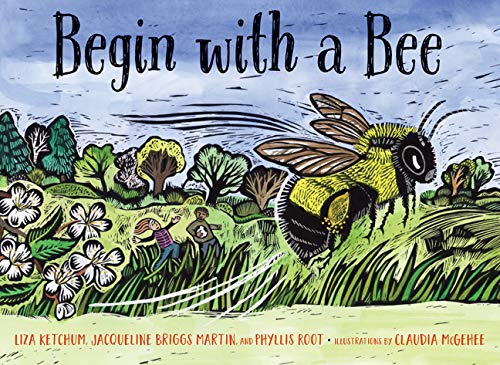
These books show how one queen bumblebee emerges from underground in the spring, finds a nesting spot, lays eggs, cares for larvae, and builds a colony of worker bees who collect pollen and nectar throughout the summer. In the fall, males are born to mate with new queens who then hibernate until the weather warms and the cycle continues.



Stories That Teach With Fanciful Elements
These enjoyable tales with characters and dialogue are obviously not completely true, but they can be used during storytime as a fun way to introduce children to some very real facts about bees.


Bees in the Ecosystem

Non-Fiction Books With Photographs
🔎A magnifying glass at the end of the notes for the book means that in addition to having photographs to accompany the facts about bees, these books also include a table of contents, page numbers, glossary, index, and resources for additional learning.
For Young Readers


For Older Readers


The following books were so close to being on our list, BUT…
If you want to enjoy and teach with these books, you’ll have to stop reading after the main content and ignore the final pages of additional facts, which is too bad because these titles are worth checking out. Maybe do that instead? These books are popular, so you’re sure to find them at your public library–no need to purchase them and support exploitation and cruelty.
- Honeybee: The Busy Life of Apis Mellifera (Fleming/Rohmann) 🐝stunning, realistic illustrations 🐝pages have detailed information on the entire life cycle of a honey bee including her time spent in each of the hive jobs and eventual death 🐝emphasizes that after a lifetime of hard work, she has only collected enough nectar to make 1/12th a teaspoon of honey and that she is willing to give her life to protect the nest’s collection BUT back matter asks readers to find beekeepers nearby and buy their honey because keeping them in business is good for bees and people
- In the Trees Honey Bees (Mortensen/Arbo) 🐝gorgeous, life-like illustrations 🐝simple rhyming phrases for younger readers included along with more in-depth explanatory sentences 🐝great descriptions of all the hard work done throughout one day by the different members of the colony that could be used to question whether or not we should take their honey BUT back matter tells how a beekeeper harvests 100-150 pounds of honey per hive in a “good season” and “leaves plenty for the colony too” 🐝available to read at Internet Archive
- You Are a Honey Bee! (Thompson/Fleck) 🐝encourages young readers to act out all of the different jobs covered by the worker bees BUT back matter includes instructions to try tasting honey, to thank bees for helping plants that cows eat so everyone can have dairy products, and to help honey bees by buying local honey
What’s missing from this list? Comment below!